Posts

Tarabai Shinde - Trailblazer of Feminism in India

Image
Her magnum opus in Marathi, ‘Stri-Purush Tulana’ (‘Comparison of Women and Men’, published in 1882) tears down the patriarchy, and the systemic exploitation and subjugation of women in India. Outraged by an incident where a widow was sentenced to execution for choosing to abort for having ‘loose morals’, Tarabai minced no words when she said “What’s good for a man ought to be good for the woman as well.” Writing in a time when there was scant public discourse on basic rights for women and girls like education, safety from physical and sexual abuse, and child marriage, Tarabai blazed through the double standards with her powerful prose. She thereafter became a close associate of social reformers Savitribai and Jyotiba Phule, and a part of the Satyashodhak Samal (‘Truth-finding Society’), espousing education and basic rights for women and Dalits, among other traditionally subjugated groups. A strong believer in agency for all women by right, from widows to sex workers, her social adv...

Pandita Ramabai - The Rebel Reformer

Image
A Sanskrit scholar, social reformer, writer and educator, Pandita Ramabai Saraswati was steadfast in her advocacy of equality for women at a time when these concepts were anathema. Although extreme personal tragedy followed her through her life, she remained a fighter for reform, working fervently for education and the abolishment of child marriage. In 1889 she founded Sharda Sadan, a school for young widows in Mumbai that taught curricular and vocational courses. Even her strongest opponent, Bal Gangadhar Tilak, finally praised her, declaring society could do with more women like Pandita Ramabai. She decided to convert to Christianity because of her personal convictions, a move that drew strong criticism back home. In 1886 she was invited to the Women’s Medical College of Pennsylvania for the graduation of her distant cousin Anandibai Joshi, where she was welcomed as an important voice for feminism in India. Her seminal book ‘The High Caste Hindu Woman’, where she describes the pli...

Rukmini Devi Arundale - Mother of Modern Bharatanatyam

Image
Rukmini Devi Arundale’s first inspiration to learn dance came when she met the celebrated ballerina Anna Pavlova after being enthralled by her performances. At 24 years old, her apprehension was that she was ‘too old to start learning dance.’ A dwindling dance from in the 1930s, Bharatanatyam had for many decades been falling apart from disrepute and neglect. In Rukmini Devi’s words, “it was almost extinct…and there was discouragement from almost all quarters…The dancers had no status or recognition.” Her mind made up, Rukmini Devi managed to convince greats like Mylapore Gowri Amma and M. Sundaram Pillai to become her gurus. At the age of 31, she debuted with the Arangetram that would change Bharatanatyam forever. She founded Kalakshetra in Chennai along with her husband George Arundale; a school of dance and music based on the Gurukul system. She continued to refine the dance form, removing from it certain elements of eroticism, while innovating on costume, lighting and instrument...

Ranganayaki Ammal - To the beat of her own drum

Image
Even today, women percussionists are almost unheard of. Heavily stereotyped to be a ‘man’ thing, it didn’t seem to stop Ranganayaki Ammal, all of 17 when she first performed at the All India Congress Session in Madras in 1926, with an all-male group of players. As most girls from South Indian families, Ranganayaki too was trained in classical dance and music as a child. Drums of all kinds however, were the domain of young boys in their initiation into Carnatic music. Always drawn to percussion, and with an innate sense of musical rhythm, she gravitated towards the Mridangam. Dispelling the usual misogyny around women percussionists probably came with its challenges, but Ranganayaki, with her mastery of mathematically complex rhythms, thrived and enthralled. The ‘Ranganayaki Ammal Award’ was announced by CM of Tamil Nadu M. Karunanidhi, to honour mridangam artists who have come after her. An award that, as of now, has been given to very few women.

Dr Muthulakshmi Reddi - A Lifelong Fight for Equality

Image
A woman whose life had many ‘firsts’ , Muthulaksmi Reddi’s first real victory was probably to beat the odds and get an education. Brilliant and feisty, she was the first woman to join an all-male college in 1907 where she studied medicine, then the first female surgeon, and in a later avatar, British India’s first female legislator in 1926. Faced with ridicule and trauma in her formative years for being born to a woman from the Devadasi community, she would become highly empathetic to the community’s plight and as a lawmaker was instrumental in passing a bill against the trafficking of women and children. (The only woman in a panel of over 100 members). Avvai Home and Orphanage was founded by her in 1931, when 3 girls from Devadasi families knocked on her door one night, having run away from home with nowhere to go. It still stands today as a shelter for women and girls, irrespective of caste or religion. At the age of 28, her mother succeeded in convincing Muthulakshmi to get marr...

Begum Hazrat Mahal - The Begum who defied Queen Victoria

Image
As anyone familiar with Lucknow will agree, Begum Hazrat Mahal was a woman whose name every child today will know. Born Muhammadi Khanum in Faizabad (c.1820) in the Kingdom of Awadh, she was sold to royal agents as a child, becoming a courtesan, and eventually the wife and Begum of Nawab Wajid Ali Shah. In the lead-up to 1857 and the First War of Independence, the Kingdom of Awadh was annexed by the British, and the Nawab exiled to Kolkata. What started as a ‘sepoy mutiny’ soon spread like wild fire, with many regions simultaneously taking up arms against the British. The Begum decided she was staying in Lucknow, and that she was going to put up a fight. Appointing her 12 year old son Birjis Qadr king, she became the regent and, uniting Hindus and Muslims as well as encouraging women to take up arms, she began to gather troops and mobilise masses, turning the rebellion into a people’s movement to reckon with. Laying siege to Lucknow, her troops continued to exert pressure on the Bri...

Kamala Nehru - Almost Overlooked

Image
Although she was from one of India’s most prominent families, Kamala Nehru was that quiet fighter whose presence and contribution can easily go unnoticed. Born in 1899 into a Kashmiri Pandit family, Kamala was just a teenager when her marriage was arranged to Jawaharlal Nehru. She quickly threw herself into the Freedom Struggle, tenaciously taking on the fight against British rule. She even converted a section of her house in Allahabad into a dispensary for wounded fighters (later renamed Kamala Nehru Memorial Hospital). At the forefront of the Non-Cooperation Movement in 1921, Kamala’s popularity among local women helped her launch a strong protest against shops that sold British liquor and cloth in Allahabad. Realising that she was fast becoming a threat, the British arrested her on two occasions. Frail and ailing for years, she spent much of her time between hospitals and sanatoriums, only to succumb to tuberculosis at the age of 36 in Lausanne, Switzerland. Her family was by her...

Rani Lakshmibai - तू खुद अमिट निशानी थी

Image
Almost a goddess in India’s collective memory, Rani Lakshmibai is that singular woman whose life has become a symbol of heroism and patriotism. Working through the deification, perhaps one can get a glimpse of the real woman. Manikarnika had an unusual childhood for a girl in her time. Losing her mother at 4, she frequented the court of Peshwa Bajirao II, taking easily to horse riding, fencing and the rules of battle. She was also literate, confident and opinionated. A teenage bride of the much older Gangadhar Rao, King of Jhansi, she would soon face her next great loss: the death of their infant son Damodar Rao, and soon, her husband. Tragedy was only starting to unfold in Rani Lakshmibai’s life. Although the rulers had adopted an heir, Jhansi was annexed by the British in 1854 using the infamous Doctrine of Lapse, thus usurping her right to her kingdom. With war raging across the plains, she set up and trained her own army in 1857 to defend Jhansi. When all seemed lost, she escape...

Women from the Indian Independence Movement

Image
'India's Freedom Struggle' was that chapter from our history textbooks that's actually stuck with many of us into our adult lives. Those of us who did school (and history lessons) in the 80s and 90s will probably recall the bits about a handful of freedom fighters - mostly men - who bravely defied a cruel, oppressive and blatantly exploitative system, to win India her freedom in 1947. Looking back, i can't help feeling that the Freedom Struggle was taught - somehow - as a movement essentially led and won by men, with the rare great woman who got a paragraph-mention in our thin-paged, single-colour history textbooks. We live in a polarised place in polarised times. Maybe now more than ever, it helps to look back at our collective past, and see if there's any context we can derive from it. Here are my tributes to a few great women, those whose words, thoughts and actions contributed immensely to India's Freedom Struggle (and who sadly didn't get a dece...

Tomiris – a Mother's Vengeance

Image
A Mother’s Vengeance In the 6th century BCE, the Central Asian Steppe was a vast and hostile terrain, where the warlike Scythians, the original horselords of the ancient world, reigned supreme. Her husband dead, her son captured by Cyrus the Great, and her people under attack, Tomiris, queen of the Massagatae (associated with the Scythians), might have felt she had little to lose. Having refused Cyrus’ offer of marriage, Tomiris knew she would have to brace her people for open war with the most powerful man alive at the time. With the Achaemenid armies closing in on her lands, she sent out a defiant message: “King of Persia…Be content to rule in peace your own kingdom, and bear to see us reign over the countries that are ours to govern.” It was when her son Spargapises died in captivity under Cyrus’ armies (by some accounts killing himself), that an enraged Tomiris gathered every single force in her command and attacked, eventually defeating them. According to the ancient Greek h...

CiXi – the Dragon Lady

Image
The Dragon Lady Few women in history have been as vilified as Cixi (“Tse-shee”, 1835-1905), the concubine who took absolute power in China, and held on to it, for almost 50 years. After a century of defamation as a Wicked Witch of the East, historians have decided it’s time to relook at her legacy. From a powerless teenager in the harem of Emperor Xianfeng, Cixi rose sharply in the ranks, becoming the Empress Dowager and effectively the person in command of China. She did this through a mix of fate (by giving birth to the emperor’s only son), and the clever move of befriending Empress Ci’an. They would be co-regents and remain close allies until Ci’an’s death. As Xianfeng sank into a stupor induced by opium and women with tiny feet, Cixi spent time studying Confucianism, while mastering court politics. After his death, she ruthlessly dismissed the men in power, putting her son Tongzhi on the throne aged 5. Cixi stood behind a scroll, taking every decision. (And so was born the ph...

Anna Piaggi

Image
"My pets are my hats." Fashion writer, influencer, icon, the Original Punk Grandmom. Anna Piaggi was also wildly experimental in her self expression. Her peculiar and insanely eclectic wardrobe spanned around 200 years, and what she walked out in was always a mix of vintage, theatrical, clownish, childlike dress-up. The beauty of it was it could never really be defined. An obsessive collector of vintage and historical wardrobe pieces, her styling was a collage of stories, eras and lives lived through time. She had a wild curiosity and appetite for clothing and accessories from auction houses, pavement stalls, vintage sellers and grand old ladies recently departed. Army fatigues and Manolo Blahniks, aprons, boas and walking sticks...each item had a life and a story. Thank you @ashdeenl my most fashion-educated friend for introducing me to her. Really hope I did even a tiny bit of justice to this incredible woman. .

Cindy Sherman – The Ultimate Shape-Shifter

Image
The Ultimate Shape Shifter "We are all the product of what we want to project to the world." Cindy Sherman is that iconic artist whose work intrigues us because it starts to reveal itself, and then doesn't. The picture holds the promise of a story, drawing the viewer in to work through the layers. The projected and overt, the woman behind the dress-up, the play on identity, the invitation to gaze, and finally, the meaning of all of these, overlayed and coexisting. Perhaps my strongest influence and inspiration, somewhere in the raison d'etre of the @iconicwomenproject lies a deep if subterranean link to Cindy Sherman. A key figure of the 'Pictures Generation', a group of American artists whose work focused on social critique in an era of growing mass imagery in the early '80s, Cindy Sherman's work takes a profound look at identity, especially female, as something carefully fashioned for consumption and deception. Turning the camera on herself in...

Fatoumata Diawara

Image
"Wake up! We are losing Mali! We are losing our culture, our tradition, our origin, our roots!" . Fatoumata Diawara's smoky-sweet voice was one of those that rang out in protest at the fundamentalist takeover of Northern Mali in 2012. . Singer-songwriter, actor and multiple Grammy nominee, Fatoumata was born to Malian parents in Ivory Coast, and in her teens fled Bamako to eventually live in Paris. . With her use of the electric guitar with traditional West African beats and sounds, she is one of the artistes thanks to whom many of us are now familiar with Touareg music. . On her emotional connect to Mali and its music, she says "Every aunt in my village, they sing only for themselves, for weddings, for spiritual reasons. The melodies are different from jazz, but the roots are right there." . I decided to give this Malian look a playful Indian twist, with a Kanjivaram sari, Assamese scarf and my favourite Malnad beads. Thank you @sithara_kudige for introducing...

Alisha Chinai

Image
As anyone who was a teenager in 90s' India will attest, Alisha Chinai was someone you noticed. IndiPop was suddenly a 'thing'... Our first taste of westernised pop music for Indians by Indians... and there she was, right at the heart of it. Finally, here was an outspoken and opinionated woman. A true entertainer, quirky, sexy and cheeky, too interesting to be lost to plain old playback singing. And she knew it. (Since I was too busy picking my jaw up off the floor when Milind Soman appeared out of smoke in 'Made in India', it dawned on me only later that it was the very first time I'd actually seen a man being objectified on an Indian screen.) Her album cover Madonna brings back the 90s nostalgia, and there she is once again on our recently-turned-color TV screen. Simple times, made peppier by Alisha. 💘💘💘

Amy Winehouse

Image
"In the entire Amy Winehouse saga, there were no winners. Everybody lost." It's hard to think of her without cliches: White woman with a black woman's voice. Part of the 27 Club. Reader of JD Salinger. Creator of her own iconic 60s style. All this sometimes overshadows her soulful, witty, self deprecating poetry and lyrics. Honest, authentic and full of self doubt, Amy's songs were her life poured out in words and music. Her ups and downs became a thing of scrutiny and social media-fuelled voyeurism as it all spiralled tragically downwards. What stays on is her absolute uniqueness. There will only ever be one Amy Winehouse. 🌹

TEDx Talk – "Our Need for Creativity"

Image
https://www.youtube.com/watch?v=nA6ZtRXi_cM&t=280s Over a decade ago, as an impressionable young woman in her twenties, I spent some time in Mexico City, where I encountered for the first time, the life and works of Frida Kahlo. I have this distinct memory of walking through her sunlit home with bright blue walls – now a museum frozen in time. The old pieces of traditional Mexican pottery and textiles strewn among her easels, gave me a sense of her deep identification with the many Mexicos past, overlaid with veneers of the present. Through symbolism and experience, her paintings were her revelations – the pain and suffering of her life, lived and recreated. I didn’t know it then, but it was these moments of connecting deeply with one woman’s quest for self realisation that left an indelible impact. Today, I'm here to share with you my experiences with what has become the Iconic Women Project. A story of  creative self expression , mine as well as those of women thro...

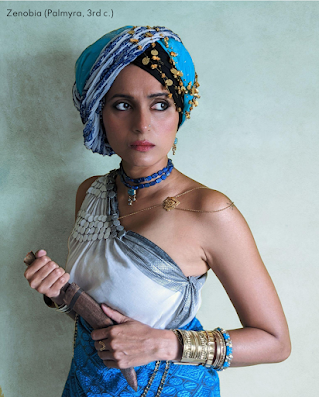
Zenobia of Palmyra

Image
The Syrian Queen who Defied Rome 1800 years ago, the prosperous and cultured province of Palmyra audaciously broke away from the Roman Empire, led by a woman named Zenobia. When her husband, King Odaenathus was killed, Zenobia became the regent in name, but the holder of supreme power behind the scenes. Taking advantage of a crisis in the Roman Empire, she took over Egypt from Rome, then Asia Minor and the Levant, rapidly expanding her empire. A brilliant military commander, she did this by waging war on Roman provinces while outwardly continuing to be the peaceful gatekeeper of the Roman East, driving her agenda with no open conflict. This worked well until the Roman emperor Aurelian decided he wanted his provinces back. He tore through her lands, destroying every city in his wake and finally defeating Zenobia’s army. Caught while trying to flee to safety, she was taken prisoner and forcibly brought back to Aurelian, supposedly in g...

Puabi, the Queen

Image
Mother of Ancient Queens Her skull crushed into tiny pieces by the weight of millennia, Puabi lay in her final resting place, undisturbed, for 4,500 years. Dressed in beaded jewellery and laden with gold, a cylinder seal next to her was inscribed in the cuneiform script of ancient Mesopotamia, ‘Puabi, the Queen’. In the patriarchal world of Sumer, Puabi appears to have been a ruler in her own right, as her name was not attached to that of a male ruler. And though the jury is still out, this might imply that Puabi was indeed the first female ruler in recorded history. Much like Hatshepsut of ancient Egypt who ruled a millennium after her, or Queen Elizabeth I, Puabi too once ruled alone, holding the symbolic branch of dates, in what were the world’s first civilised cities. Changeless in a changing world, along with her grave were unearthed the stories of grisly mass murders in an ancient ritual of human sacrifice; servants, musicians, guards and anim...

Esmat al Dowleh of Qajar

Image
The Beautiful Princess of Persia A few years after the first-ever photographs were released in the mid 1800’s in France, the Shah of Persia had experts brought over as his court photographers, to ‘objectively’ record his reign of glory and power for the world to see. The most photographed woman in Persia, in ‘modern’ dress at a time when strict veiling and seclusion were the norm, Princess Esmat al Dowleh became a symbol of a rapidly modernising nation. What struck the world, apart from her downy moustache, unibrow and large frame, was how proudly she seemed to carry them. Considered a symbol of beauty and strength, women of the Qajar Dynasty embraced facial hair, even flaunted it. Under the progressive reign of her father, Shah Naser al Din Qajar, the court attire of the entire zenana changed from floor-grazing hejabs to tutu-style skirts (thanks to the growing cultural influence of Russia on Persia). Known for her special knack in diplomacy, Esmat al D...